What is a Quiet Zone?
In 2005, the Federal Railroad Administration issued a final rule declaring that trains must sound their horns at all public train/highway intersections. However, this final rule also offered a new option for communities to establish train Quiet Zones. A Quiet Zone is a section of track where train operators are not allowed to sound their horns unless there is an emergency or imminent safety risk such as someone walking along the track. Communities must qualify for Quiet Zones by installing Supplemental Safety Measures (SSMs) at train crossings in order to overcome the additional safety risk that might result from silencing the train horn. Typically, these additional safety measures include medians at crossings so vehicles and pedestrians can not go around the crossing gates. Safety is the primary concern when it comes to implementing a Quiet Zone. In fact, Union Pacific has stated that safety has actually been improved at train crossings in Quiet Zones. The Federal Railroad Administration must give final approval of all SSMs and Quiet Zone proposals.
There are currently over 350 Quiet Zones around the country (see list here). Houston has lagged the nation and Texas in establishing Quiet Zones. There are 82 Quiet Zones currently in Texas. In Houston, there are currently only a few Quiet Zones that have been established including the West U/Bellaire, River Oaks and Washington Corridor Quiet Zones. Click here for a good overview of the West U/Bellaire Quiet Zone by the former project manager. Click here for a presentation on the West U/Bellaire Quiet Zone given by the current City of Houston Traffic Transportation project manager. There are currently 16 or so Quiet Zone applications pending with the City of Houston. Most Quiet Zones are 24 hour zones but some are partial zones which are quiet between the hours of 10pm-7am. The proposed 34th St Corridor Quiet Zone is a 24 hour zone. It is important to note that funding has been set aside specifically for Quiet Zones in Houston. The money currently allocated to Quiet Zones will not be spent on other programs or issues in our community.
What are the benefits of a Quiet Zone?
There are numerous benefits from having a Quiet Zone in a community. Athough trains have been in communities for decades, a Quiet Zone is a relatively new option for residents to improve their livelihoods and improve their communities. The primary benefit will be improved quality of life and a reduction in health impacts of the train horn. Residents all along the span of the Quiet Zone will no longer hear the train horn at all hours of the day and night. Although the train horn may not disturb someone enough to cause them to wake up at night, studies have determined that train horn noise still interrupts sleep patterns and can lead to serious health problems[1,2]. One noteable quote from the studies: "Even subtle noises at night that may not awaken people may disrupt sleep quality (Heaner, 2004) and Maschke, et al (2004) conclude as follows: “Noise-induced activations may interfere with normal sleep stages and cause awakenings. Undisturbed sleep brings about health, well-being, efficiency and optimism. Long-term sleep disturbances, however, may induce adverse health effects of various kinds and intensities.”
A Quiet Zone will also spur development along the train track improving the value of a community and property values. The safety upgrades required at crossings within a Quiet Zone will also make the crossings safer.
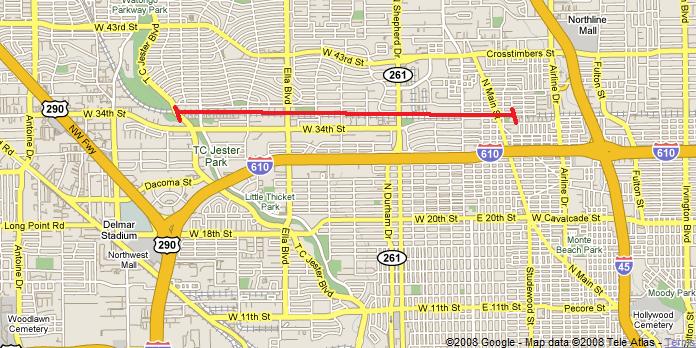
Where is the proposed 34th St Corridor Quiet Zone?
Map of proposed 34th St Corridor Quiet Zone (red line on map below):
Click on map for larger view.
What is the timeline for implementation of the Quiet Zone?
The first step in the Quiet Zone process is getting approval from the City of Houston. We are currently petitioning for that approval. Once the Quiet Zone is approved, we will get a better idea of the timeline for implementation.
Click here to learn how YOU can make a difference